I’m James, a GP in South Devon, current Deputy Chair of the RCGP Health Informatics Group and Secretary of the BCS Primary Healthcare Specialist Group.
I know this conversation comes up regularly. I have considered it for a while and was inspired further by discussions with Marcus and on this forum. I think now is the time to act.
We need a team to develop, in house, open-source tools for the NHS.
We need to bring together a group of highly motivated individuals who can bridge the gap between clinical experience and software development. The aim would be to start building a catalogue of production-grade tools available for deployment across the NHS.
The benefits of this approach are significant:
Aligns well with the quintuple aims of improving healthcare systems: improved patient experience, better health outcomes, reduced costs, improved clinician wellbeing, and greater health equity
Development is clinician-led, meaning we identify the actual problems we face and how best to solve them. Finding and building ‘solutions for problems’ not trying to find ‘problems for solutions’.
We can be agile, move quickly and take advantage of new developments as they emerge
We can help reduce/avoid some of the potential negative aspects that can occur with commercial tech such as - the need to improve profitability, ‘stickiness’/vendor lock in, restrictive contracts, investor pressures, questions around how data is used.
I recognise that open source doesn’t mean free/zero cost. There will be hosting, maintenance, and other costs such as AI inference if used in tools. There is also the factor of the cost of our time in contributing to any projects. But I think there are some realistic routes to sustainability:
Possibility of commissioned projects and funding
Clinical safety and implementation work
User training
Hosting
Offering services to international providers if this can be established as a reputable and reliable source of healthcare tooling
If we need a ‘vehicle’ or brand, I have CliniPrompt we can use, though I’m not fixed on this and open to alternatives or joining forces with existing groups.
Interested in peoples thoughts on this. I thought I’d set up an introductory call in the next couple of weeks. If you want to be part of this, let me know and I’ll send you the details. It will be important to have both clinical and more technical focused people involved.
My view is also ‘solutions for problems’ but probably not a solution. Defining problem + user/pathway requirement well enough to get a good solution is a known issue.
For example in NHS England - a clinical problem is turned into a solution before it hits developers, this eventually leads to ‘problems for solutions’
Count me in too. We are doing pretty much what you’ve described, but just in relation to Open Integration Engine, the rescue fork of Mirth Connect. We have put it through DCB0129, have our DSPT, ISO27001 etc and have had our first couple of successes in persuading NHS Trusts and system vendors to migrate to OIE and avoid license costs from NextGen.
We’re on the cusp of making self-provisioned OIE instances available for non-production purposes. Let me know if any of you are interested in kicking the tyres.
I’m in. Great to see there is appetite for doing this stuff.
My thoughts below:
Agentic coding
Some of the work that used to take many months in the past is now much faster since the advent of LLM-assisted coding - but it does still need some technique to make it work! And of course all the clinical safety, MedDev, and data standards that were always required are still required, so although the bottleneck has moved, there is still challenge. As clinicians and health IT experts we are advantaged now because we have domain specific knowledge.
Existing projects
I would strongly recommend that we don’t start loads of new projects if we can find existing projects to contribute to. One of the side-effects of agentic coding is that it’s going to result in a GitHub-pocalypse global proliferation of low-value open source personal side-projects, when that effort would be better spent in collaborating on a smaller number of high-quality projects.
Organisations
Having seen many organisations rise and fall in a decade and a half of health tech - I would advise against hitching this wagon to any orgs that we don’t control - ie NHSE/D, DHSC etc. James’ suggestion of CliniPrompt would be fine. I also own the openhealthhub-org repositories · GitHub which I know @mayfield.g.kev has already made use of.
From my own experience the NHS does a poor job around forms - I was at a Leeds open source event where this popped up, yet again for referrals.
Technically this has well known patterns:
complete a form and click submit
in secondary care this is often transformed into HL7 for transmission
however more likely, it’s turned into PDF and emailed.
complete a form and decompose into resources for reuse (← This is Structured Data Capture and allows for existing data to be used to pre-populate questions)
clinical informatician will often say the answer is openEHR (this actually can work with Structured Data Capture, and the above but saying so may get you black balled)
I think putting this altogether would save the NHS millions of hours (as long as we accept all these patterns are correct, and don’t go down “One Ring to Rule” them all route).
The rest of the spec Laboratory Testing Workflow (LTW) - NHS North West Genomics v0.2.1 covers how it sent to a LIMS and how the LIMS shares it - I don’t directly cover Structured Data Capture but the pattern is present (in NHS Trusts, they implement a version of this form and it’s gets turned into HL7 v2 for the electronic order).
This is also roughly how clinical referrals (and pathology and imaging orders) work.
Thank you everyone! Great to see such positive responses and enthusiasm.
To me it makes sense that if we can organise a structured and co-ordinated approach to this as well as shining a light on the outputs and potential, it would be a good direction.
At present, I imagine there are many clinicians and teams with ideas, working in isolation. A lot of these projects with potential might get stuck at early stages for some of the reasons @pacharanero mentions or their outputs do not reach others that may benefit.
Agree about the bottlenecks shifting with the barriers to writing code and the requirements for large development teams reducing. Will need to stay clear of the idea of ‘vibecoding’. I see it as having a system where not a single line of code gets written until a plan and specification for each aspect of a tool is considered and agreed. The new bottlenecks mentioned - device regulation, data standards etc are aspects that I think members of this community and frontline clinicians may be some of the best placed to address.
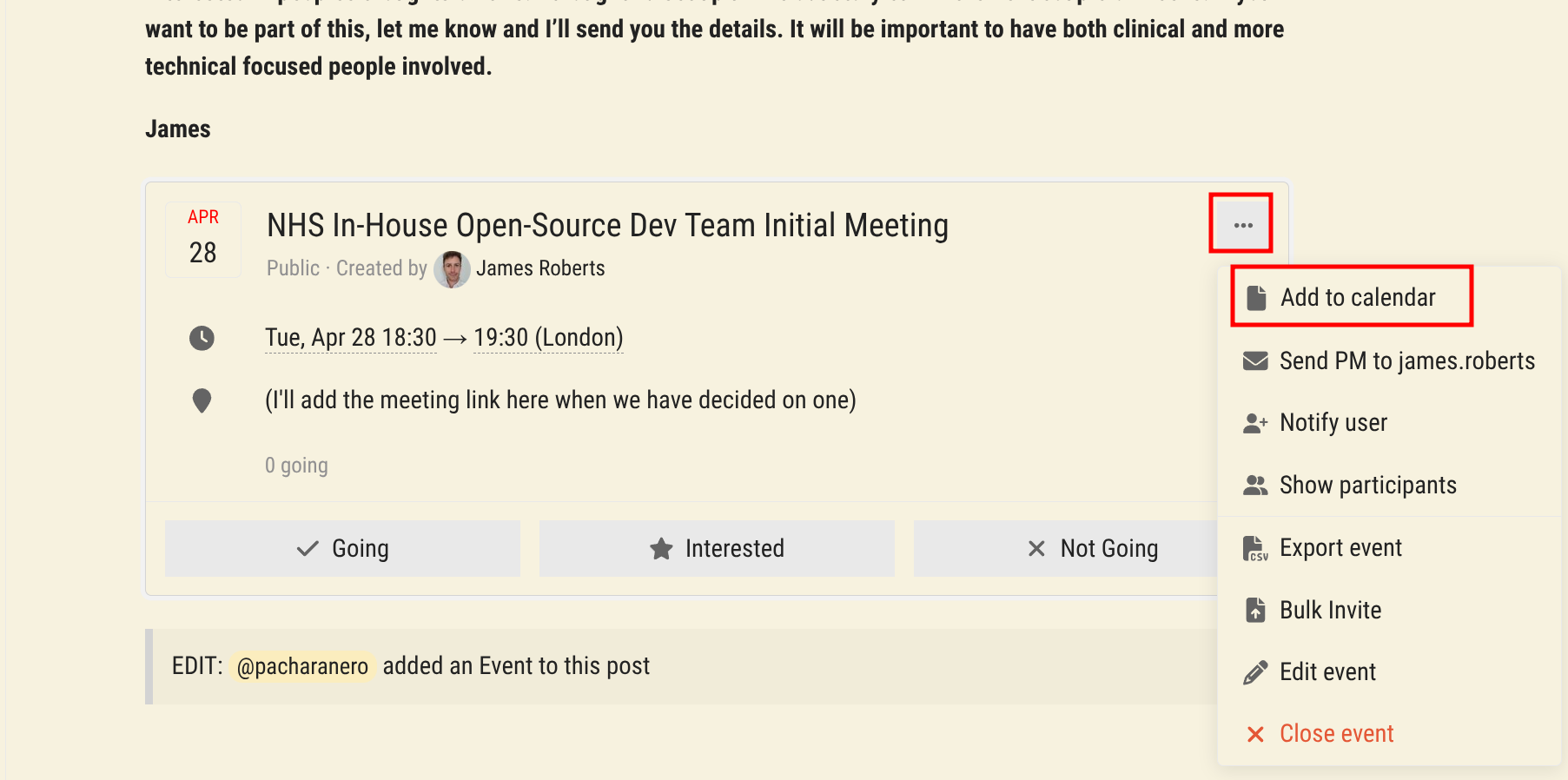
Looking at calendar and upcoming Easter holidays, can I suggest Tuesday 28th April 18:30-19:30 as a time for anyone interested in being involved to meet? Do not worry if you are unable to make this time. I’m happy to talk separately.
This should give me some headspace to put some thoughts and plans together. In the spirit of open source I will share the document when available and encourage any suggestions.
Please also keep the ideas and discussions coming as there has already been some interesting discussion on this thread.
Irritatingly, despite it being 2026 and all, Discourse still doesn’t really have a great way to send out a Calendar invite which will be notified out by email and contains the right mimetype text/calendar that you can all get it auto-added to Calendar.
What it does have is the ability to add an Event to the first post in a Topic, so I will take the liberty of doing this for @james.roberts right now. Once I’ve done that you can click on the … button in the top right of the Event and there is an Add to Calendar option. I am so annoyed at this lack of a basic feature in Discourse I’ve raised a feature request.
I think health is too focused on recording data and is biased to data doctors want. This means workflow or patient care coordination is not as good as it could be - this is often not supported by primary, social care, social prescribing or community systems (nobody wants to pay for it?)
For example around my dads care, all the social workers and nurses had minimal support from tech (other than texts, emails, etc). They were all trying to work out who should do what, when and what for. Most had no access to my dads basic record - some levels of interop between suppliers were embarrassing (EOLC/ReSPECT form arrived 2 days after it was needed, we had an information governance discussion to get it to his house)
Within this area is a large number of forms (@mike.bainbridge point) which includes a lot of transcribing from existing data sources.
Also in this area is physical activity and virtual wards (both are patient monitoring probably using smart devices).
Agreed, whilst clinical data is important the social daily workflows are just not there. With my mothers care, I recognise the staff change overs and varying medical inputs it’s so hard to keep a track on simple basic care needs.
I once heard of a record system that connect family records together. I think this could be really inspiring. Not necessarily seeing those other records but understanding the core fundamental aspects of stresses and support networks could be really interesting as a concept. Families, student homes, community housing make such a difference to wellbeing.