SNOMED, Genomics and Clinical

Sonia Patel posted this recently AI in Healthcare: Hype or Reality? | Sonia Patel FBCS posted on the topic | LinkedIn
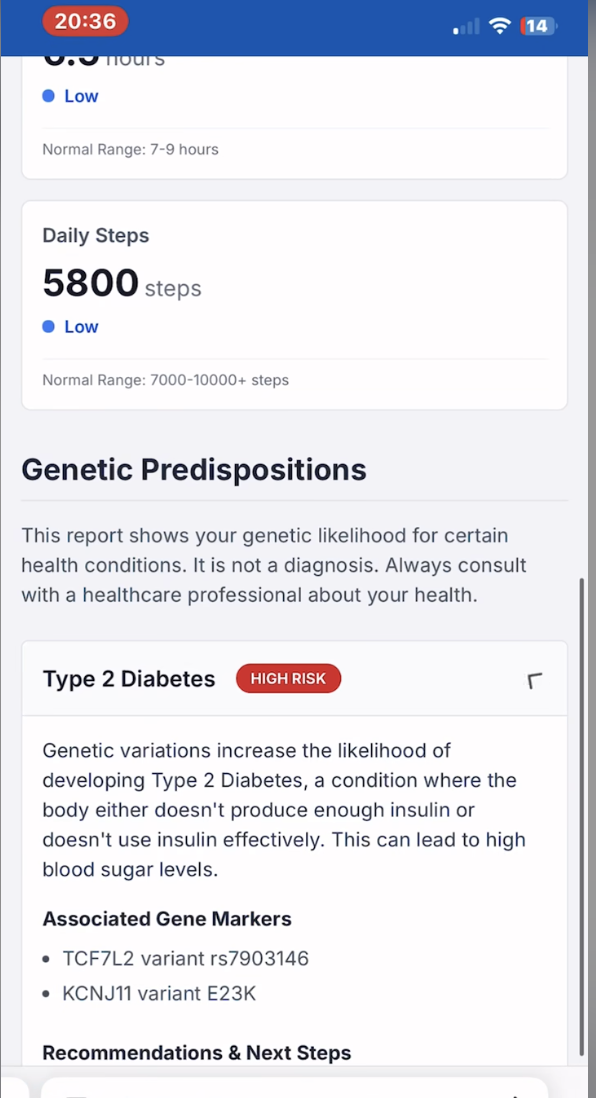
I was intrigued by the use of myDNA DNA Reporting Services I myDNA Precision Health together with NHS App, it showed genes (Variants) and the possible conditions this implies (in standards this part is called Diagnostic Implication, the screen shot calls this Genetic Predispositions). I really liked how this post presented the problems and tech.
Then a few days later my daughter mentioned she had FOXO3 (Variant) and this came from both parents (Homozygous), which also has implications.

Since then I’ve started to look at how this would be represented in a Genomic system North West Genomics Test Report - NHS North West Genomics v0.0.8 ← this gets a bit complicated but I’m aiming to focus on how this was presented in the linkedin post and how my daughter described it.

Where I’m up to at the moment is wondering how a GP or Consultant would record this in an EPR system. (I know how EPIC would share this thanks to it’s open api documentation Specifications - Epic on FHIR ) and how to get it into an EPR (from US supplier) using HL7 v2 ORU_R01)

I think a GP would either record a clinical entry (Observation) or problem (Condition), for Observation I think the codes are:

Observation

Probably need access to a clinical coder in primary or secondary care but I’m currently in diagnostic testing. Probably making this difficult as I’m employed as a developer and need to pass this up the chain.

Any views?
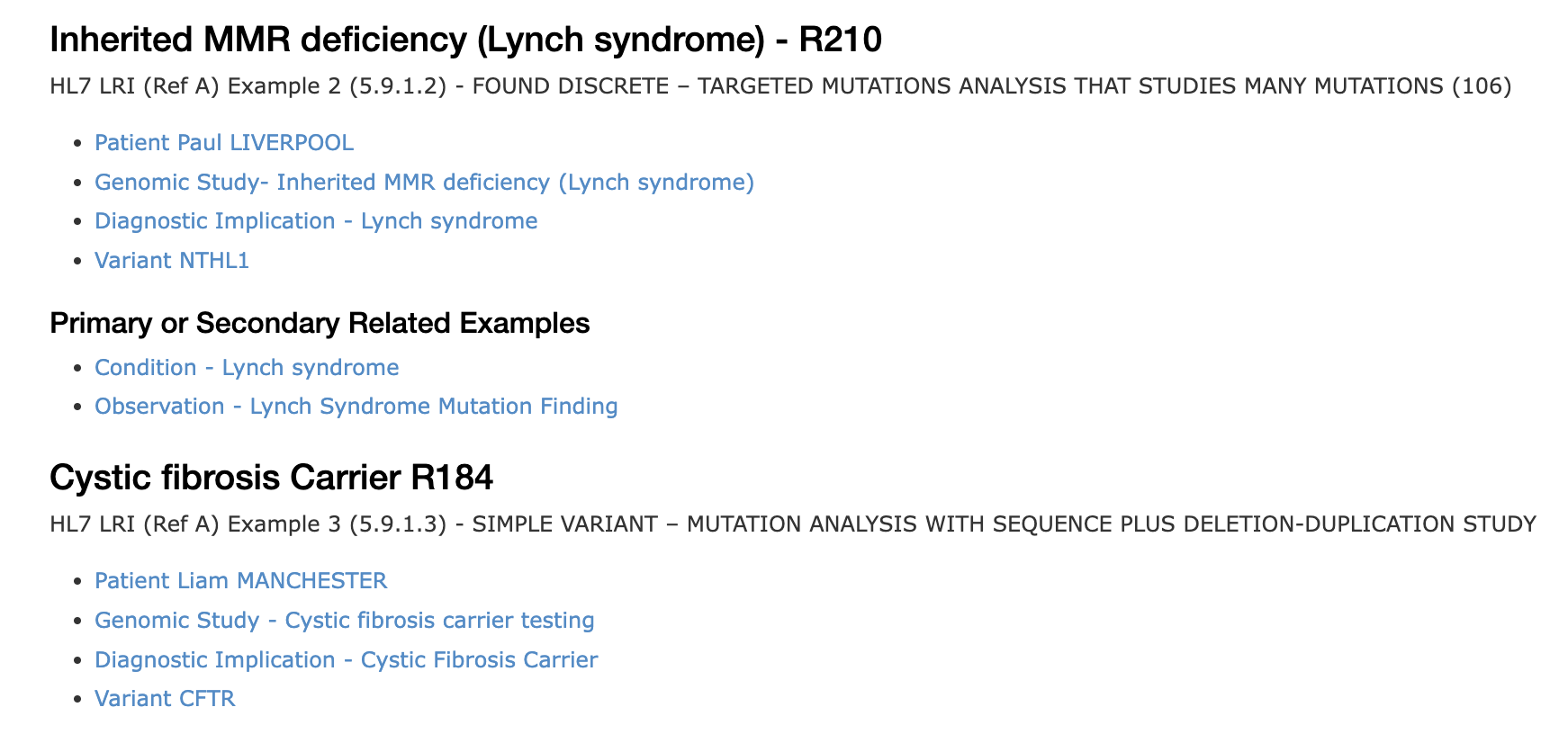
I’ve done some examples if it helps understand what I’m talking about. These are around genetic conditions the NHS tests for - it doesn’t cover tests in shown in the NHS England demo.

I know a clinician-who-codes and a geneticist that could help with this if needed

KCNJ11 is not really type 2 diabetes. It is one of the MODY panel

I think the interface is great though and I could find uses for it with other definition difficulties around genetic epilepsies.

Maybe.

I think the problem I have is that I sit in between two viewpoints - genomics which is quite detailed and more general clinicians plus patients which is less detailed.
I am sat organisationally in the genomics camp and so getting the later views is more difficult.

Another viewpoint would be oncology and I think that gets more complicated (but this perspective might be easier to get) e.g. Home - minimal Common Oncology Data Elements (mCODE) Implementation Guide v4.0.0

Hi folks, sorry I’ve not been engaging much with this. One problem here is that there is a world of difference between simple polymorphic variants (which we all have) that may increase or decrease our risk of a particular common condition or phenotype (the world of “polygenic risk scores”) and established pathogenic variants that confer a greatly increased risk of a rare genetic disease. These get confused, and it’s arguable whether the polymorphic variants should be reported at all. The background evidence is often incredibly weak, or clinical/personal actionability is negligible. So we need to be careful how we go, and how these relatively minor DNA variants are presented to patients, or incorporated into CDS.

3 Likes

From what I’m hearing it is also also difficult for clinicians to understand.

I am thinking it should be driven by these clinicians (and patient), when you mention CDS I think am also see GP. (As far as I’m aware these reports aren’t actually getting to GP’s at the moment in structured format, they are possibly available via some Health Information Exchange / Clinical Portal tech as unstructured PDF).

Talk of the devil. Hi @shanemuk

Still rocking my Psion 3mx :slight_smile:

1 Like

We have been working with @shanemuk’s team on familial cancer screening and there are quite a number of other viewpoints along the way between the raw variant detection and the end-clinician, all of whom require more/less granular and derived genomics information e.g Clincal Scientist review, MTB review, Genetic counsellor, and then eventually some sort of clinical endpoint where I agree a much simpler perspective is often required.

Shane has produced some fantastic documentation on the process, which has been invaluable in understanding all of the different inputs and outputs required along the way. Ultimately, the tech has to support ‘The Whole of the Moon’ IMO and that means much more complex than just the end ‘phenotype’.

Oncology is even more complex - we are just about to dive in on Lung Cancer with the Karolinska hospital.

Fortunately, PGx is much simpler since the key phenotypic info is much more readily derived automatically from the raw variants

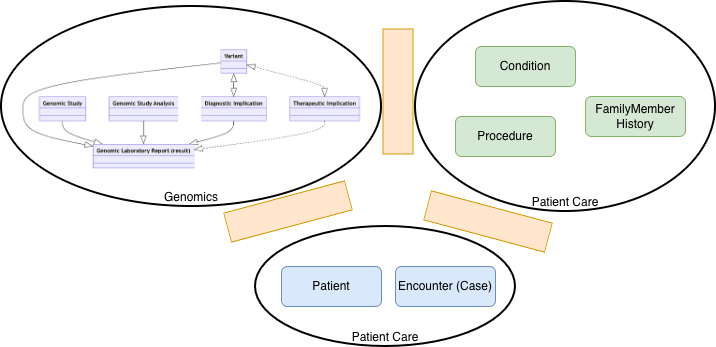
I’m using this diagram to summarize ideas from several architecture books, mainly focused on Domain-Driven Design (DDD). Martin Fowler article Bounded Context ← This theory is particularly evident in IHE, DICOM, HL7 v2 and FHIR, openEHR also tends to not cover common domain models .

In short, certain technologies—particularly those that operate exclusively within the Genomics domain—need to stay domain-specific.

Others, like my work, focus on making this detailed genomic data accessible and usable across other domains. This cross-domain integration is typically a subset of the full genomic data, determined not by what experts within genomics want, but by what practitioners in other domains actually need.

This distinction also highlights the existence of different types of data models—summary and detailed.
Most communication between practitioners across domains happens at the summary level. For instance, a condition might simply be represented as text and a code, such as “Karen has Lynch Syndrome (716318002)”.

The summary and detailed models may use different data standards. Elements from a detailed model (standard O) can sometimes be incorporated into a summary model (standard H). However, the key reason standards O and H differ isn’t just technical—it’s because practitioners in different domains have distinct needs and perspectives.

p.s. you can guess what O and H are…

p.p.s. this wasn’t generated from chatgpt :slight_smile: honest

p.s. thanks @ian had a couple of things you mentioned echoed by one of the NHS Trusts in region.

I’m trying to hold off the cancer part until we’ve done a first pass (Want to get structured started and visible as quickly as we can - I do think we may be able to get IHE + v2 + FHIR + openEHR into same health ecosystem, all doing jobs they were designed for :slight_smile: )

Forgive me for thread crashing …. but some spooky Halloween ghouls dragged me here!

Tonight, while smashing my email search-box with some retro-tech words (“PDA”, “Palm”, “Psion”), trying to resurrect some 20 years+ nostalgia, guess what pops up first?

“shaneuk” - yesterday!

To be clear, Shane and I have never had a scary-terrifying-interop-spat; quite the opposite - his epic Nazareth Challenges give me those good feel goosebump-cycle-envies.

Instead, “rocking my Psion 3mx” genuinely spooked me.

Now, my kids would physically remove me from the house if they even thought I knew the word “rocking” existed - or even read it. But since they are now asleep, I’m safe!

Instead, it was this cheeky “Psion 3mx” admission that got me nervously rocking back-and-forth!

Why? About 30 hours earlier (4:37am on Thursday 30th - yes mid-life sleep hygiene is going very well thank you) I posted a Psion-themed vignette.

What are the CHANCES? Of all the meaningless, jumbled and sleep-deprived (me not Shane) words we could have both uttered this week, we both hijacked “Psion” independently. Cosmically absurd, right?

So, I’m here to oust those heebie-jeebies with some group therapy.
B I Z A R R E. I was chuckled.

For you "rocking” PSION crazies, here is the vignette: A story - GRFX 3a and the Titan - Google Docs

P.S. The vignettes are a little thing to do with the that mid-life thing :rofl:. Secretly, I’d prefer a broom-broom shiny metallic red MX-5 on my driveway.
But the guy in the mirror keeps saying “Trust me, dude - vignettes cause fewer rows……don’t do it!”.

So the MX-5 is currently hiding at my mate’s house!

1 Like

LOL - hi Amir! It’s all about hitting the right use case :slight_smile: We Psurvivors are a scant band for sure, but I’m still using my 3mx every day - 5mx pretty frequently too. I sometimes hack at a bit of code to build a mind-mapping tool that would (in my imaginings) be perfect for openEHR archetype construction…

And @AmirMehrkar that is such a brilliant story - absolutely love it. And your dad totally rocks. There’s a small but hugely supportive Discord channel talking all sorts of mad Psion stuff over on psion.community - what I Iove about your story is that the key is the understanding of what’s going on, rather than just getting the “right answer”. I think this is hugely applicable in healthcare, especially as we hit the AI deluge. What we need to work towards is a “show your working” culture.

Ha yes, it amuses (annoys) me how as a developer I’m told to do something but often I don’t know why! (I do eventually work this out but often in the wrong place - during testing).

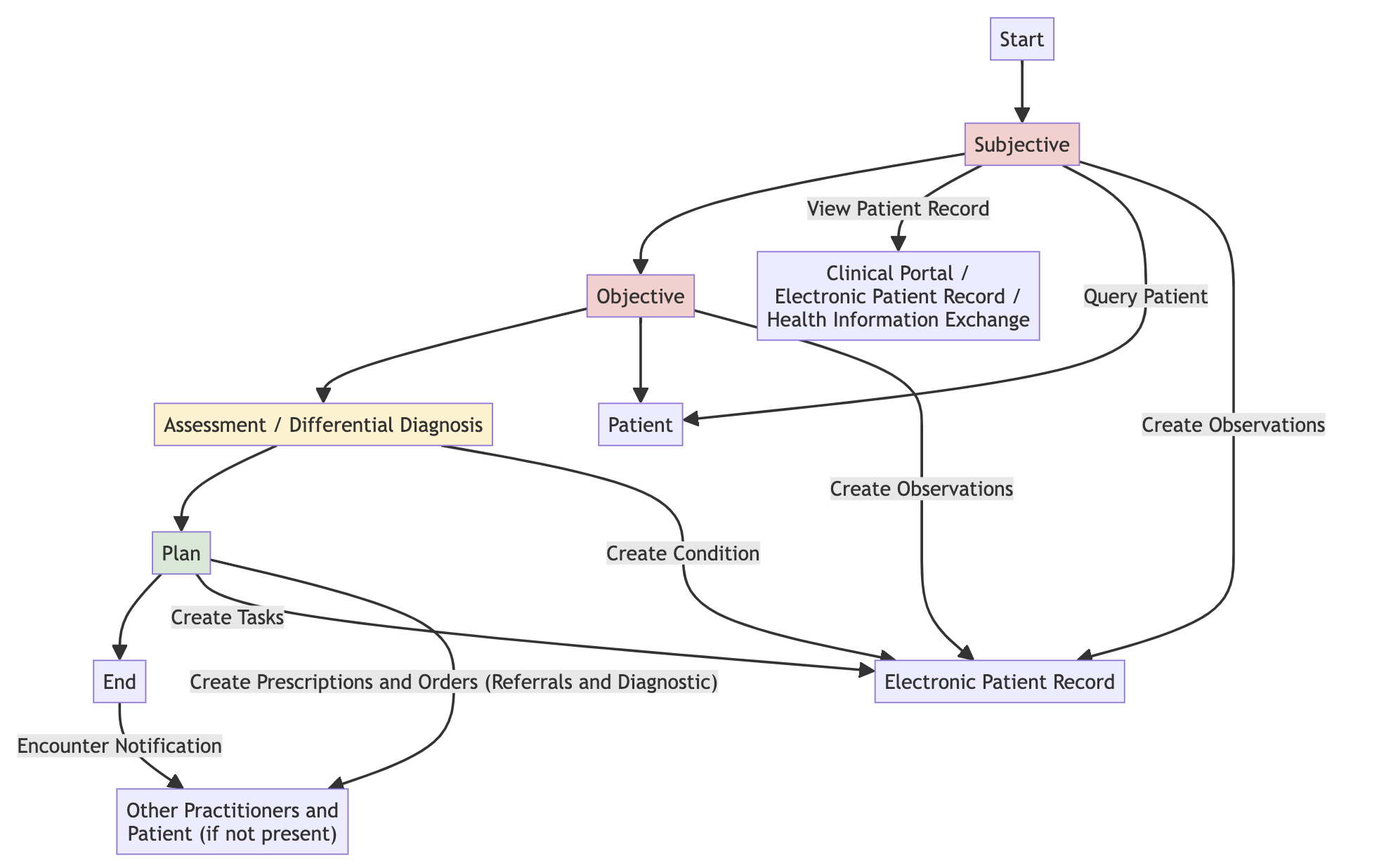
Take SOAP Note, first introduced to this 30 years ago (but without the note bit) and my tech team lead showed me how a GP did a consultation - the SOAP part with text and clinically coded entries being recorded against different paragraph headings. The main change to this description I’ve made is:

emphasising the practitioner (not just GP) will want to review the entire patient record (not just the GP record) during the consultation.

Obviously a patient will want a practitioner to be able to view their entire medical record (and not have to tell the practitioner their summary medical history at the start of an encounter/consultation).

My gist for a Patient Encounter (wss based around a day case biopsy for diagnostic testing).

The Start included getting a patient record from a patient (During admit patient stage), surely nurses could be put to better uses?

1 Like

There are definitely steps in the flow where an algorithmic AI approach could be useful. My first “EPR” was “WardRound” for the Psion 3a (not sure if any of the Psioneers on here ever used it) and it used a SOAP format - it was actually aimed at what we then called Junior Doctors on a ward, to track their patients and tasks in a sort of visual format, so you could see where they all were, and look up what needed done etc. Funny, nearly 30 years on, we need ways to reduce the cognitive load, and sometimes the best way of doing that is by a human-based summary.