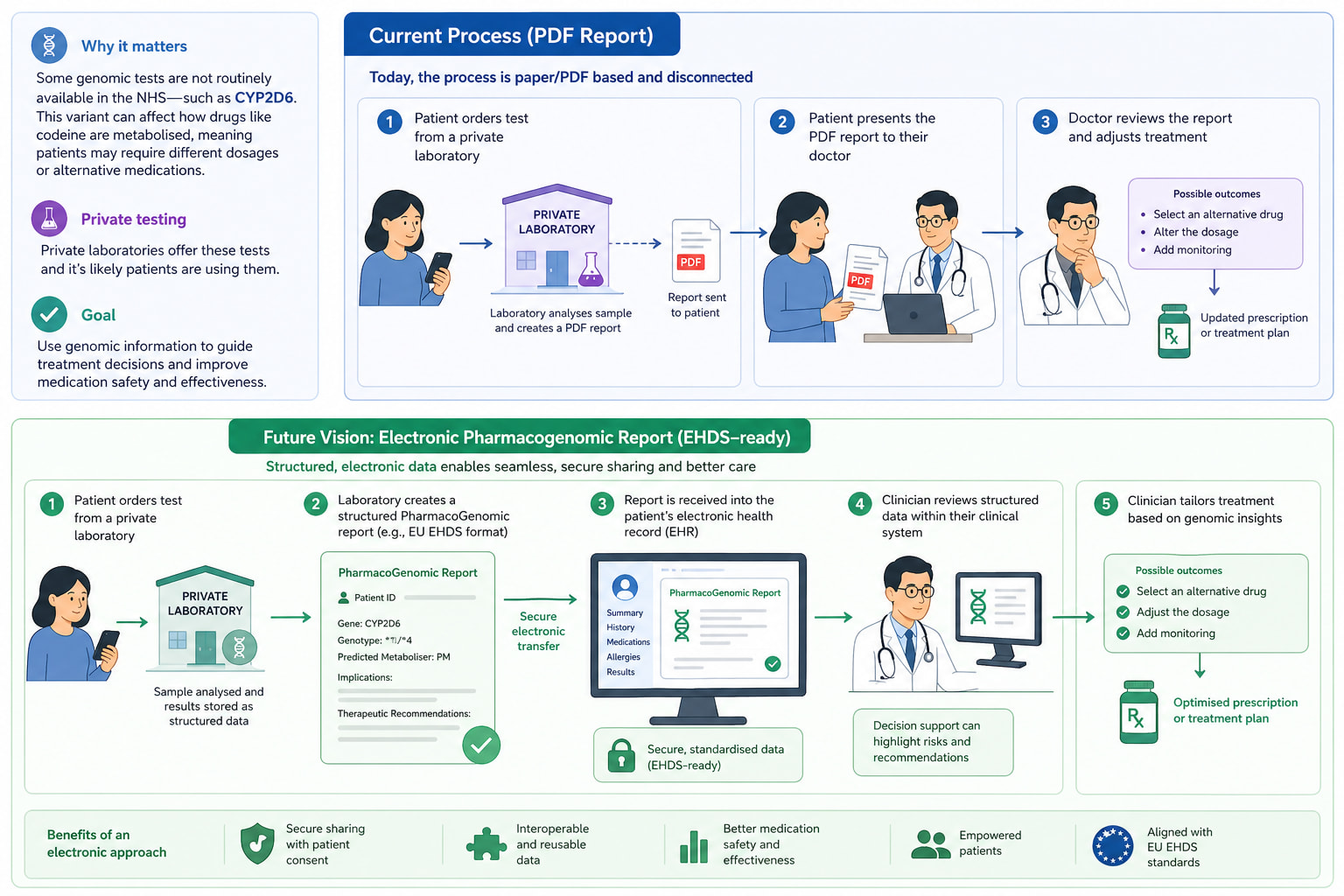
I think the core problem is that the NHS remains too paternalistic. One of the most visible consequences for patients and families is that practitioners rarely share records, except in limited circumstances.
This issue comes up repeatedly. Developers—including NHS developers, clinical informaticians, and practitioners who code—can see relatively straightforward solutions, so the barrier isn’t primarily technical. Even on moderately complex care pathways, it’s common to encounter practitioners who “don’t know what they don’t know,” and therefore rely on patients, families, or carers to bridge information gaps. In practice, the workaround is often to retain copies of correspondence as printed documents or electronic images.
In my dad’s case:
-
A family member assumed the NHS automatically shared information, which led to key details being omitted or unintentionally altered.
-
The ReSPECT form wasn’t available in the home, so other providers—including another secondary care trust—were unaware of his primary condition.
I suspect many others have experienced similar issues.
From a carer’s perspective—particularly with an NHS technical background—this is deeply frustrating. We’ve had workable solutions for years, even decades. They may be simple, but they are effective across many care pathways. In my family, several carers also had NHS experience and knew how to navigate communication gaps. Frustratingly, the available technical solutions and the communication challenges within the NHS are often closely aligned. For example, with ReSPECT: a family member’s description of the process maps naturally to an off-the-shelf technical solution, whereas the NHS approach tends to diverge into something more complex, often driven by the needs of a single care setting or individual practitioner.
There are already two internationally recognised approaches that address this:
International Patient Summary (IPS):
https://international-patient-summary.net/
This enables patients to share key clinical information—typically as PDFs or structured documents—with practitioners. It requires minimal infrastructure and works across organisational and national boundaries (e.g. a UK patient needing care in Scotland or abroad). From a health informatics perspective, this is a document-based approach (e.g. CDA, FHIR Documents, openEHR compositions).
International Patient Access (IPA):
https://ipa.hl7.org/
This focuses on patient-held applications, giving individuals API-based access to their clinical records. It also supports document sharing (such as PDFs), which is currently one of its most practical and widely used features.