So two things I wanted to discuss with any interested parties…
The first one is about stacked branch coding
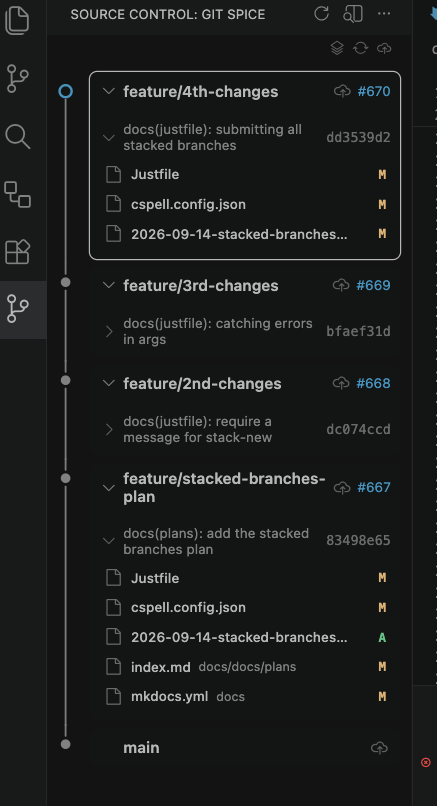
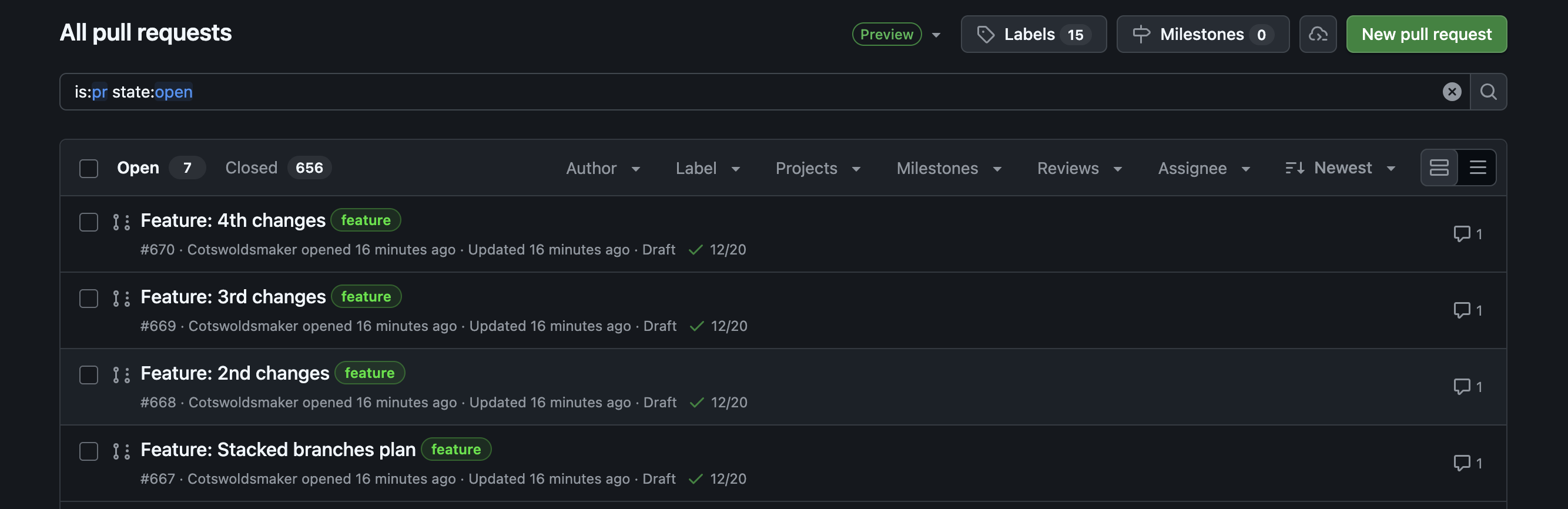
I have previously used [Graphite](https://graphite.com/) to do stached branch coding. For those that are new to this, this is basically a practice where you create a branch, feed it code, and then create a realted branch that has a copy of the previous branch and any new changes. This is really useful for when you want to make (commit) small packets of work, for a large featureset, that are human readable (in say 20-30 mins) and hence managable. As I do ALOT of coding now with the help of LLM (but, to reassure all of the CSOs out there, every line of code is read and refactored for safety and to align with clinical knowledge), I have been thinking of how to streamline my workflows. I was hoping to a) write a fully detailed plan for an new feature, and b) get Claude (my new BFF LLM) to run overnight to write out the code to spec. And then c) the next day, read through all of the code changes and refactor as needed.
I had previously done this kind of things with just simple commits on the same branch, but it was hard to review and refactor without some sort of branching aid. And regarding just using Graphite, unfortuantely you have to pay once you start using it for more extensive things. I need to keep things on the cheap (costings not quality) to be viable as a single Clinician-who-codes.
So I just came across [git-spice](git-spice). I am going to try it out and see if I can use it along with my LLM to create code when AFK. Anyone else used it? Perhaps any other recommendations?
LLM token costs
I wanted to check if others that use a lot of LLM tokens for their coding work are finding it quite expensive. I was using Claude via the VS Code Copilot for most of August and racked up a bill of $578 from the 1-23rd of August. It was expensive. I naturally looked into alternative costing streams. I found that if I payed £90 a month for Claude Max 5x, which I have been using since the 24th of August, I can quite comfortably push the LLM hard to do the work I am up to. Indeed, I now have 4 worktrees on my dev machine +/- 0-2 Claude Code Web sessions running simulatinously most afternoons and still only hitting max 60% of my 5 hour LLM token usage limit. So from almost £600 to £90 a month, just by changing the costings model and bypassing Microsoft (the owners of GitHub and VS Code). Has anyone else seen this costing trend?
Interestingly, when I was looking for an alternative costing model for my LLM coding work, Claude Chat was no use at all at recommending an alternative. It was only via trial and error that I found out that using Claude Code directly rather via VS Code Copilot could I afford a huge saving.
So I looked into Github stack. It is all CLI on the local dev machine with no nice GUI (I like GUI where possible). It has Web interfaces however, I was able to turn my git-spice stack into a Github one. I have not tested further.
In conclusion, both Github stacks and git-spice do not match what Grahite currently has to offer. I will wait for Github to finalise the work they are doing on their version.
I haven’t used git-spice but the problem it is solving does resonate with me - when working with multiple simultaneous agents you can end up in branch/PR hell not knowing which order they need to be merged in, when in fact the order kind of doesn’t matter for the code, only for git. Rebasing is the way I handle this, but it is natural that better ways will evolve.
As for LLM token costs I am containing costs by using subscriptions, not metered API calls. This is what I have:
OpenAI ChatGPT Pro 5x subscription ~£75 per month (Astra, Sol, Terra, Luna)
Anthropic Claude Max 5x subscription ~£75 per month (Fable, Opus, Sonnet, Haiku)
Ollama Cloud Pro subscription ~£15 per month (open weight models: GLM-5.3, DeepSeek, Kimi, and many others)
Via one of my employments I also have access to many of the above models via GitHub Copilot, but the allowance is almost useless - it’s easy to blow the entire month’s allowance on a small project using a cheap model on a low thinking effort level. Then you are locked out for the rest of the month.
A really important difference in how I use these models is that I hook them all into opencode, running in the terminal inside VSCode. (To do this for Anthropic via subscription there is a little workaround you need). Once you have all the providers connected, you can pretty much ‘hot-swap’ models/providers without having to change harnesses. This allows you to manage your usage across OpenAI/Anthropic/Ollama so that you don’t max out. If you do, switch to another provider where you do have usage still, and carry on.
Occasionally (but not that often) models can get a bit ‘confused’ if you swap right in the middle of work, but you can mitigate this by having a good AGENTS.md or non-provider-specific equivalent, some overarching house-style rules, and of course the entire context window is still going to be fed into the new model anyway.
If anyone wants a video walkthrough of my coding setup I am happy to make one.
I use a Claude Max 5x subscription for my projects. I use the Fable 5.1 model at Medium effort when developing OpenConsult and GermOS GitHub projects. I run out of Fable 5.1 tokens within 4 days and wait till the next weekly reset. Perhaps my development process uses twice as many tokens as using Claude Code alone. My method is a team of three: I verify every stage by eyeball; Claude Cowork writes each stage’s one-page spec for approval, reviews every diff, flags the judgment calls; and Claude Code writes the code. I start fresh sessions after each stage to manage the context window bloating. This method fills the gap in the coding skills I lack. Other times, I use Opus 5. Opus 5 barely moves the token meter. My desktop runs Ubuntu with Claude Desktop installed.
Marcus, I too use Open AI Pro and Anthropic Max 5x subscriptions at $200/month. I then signed up for Grok/Cursor and just paid for annual membership to save some money. So, I bounce around with these three but like everyone else, Anthropic is the best, Open AI is second, and Cursor/Grok is distant third. How do you find Ollama Cloud Pro subscription to be? I have used DeepSeek and Kimi before but just gave up on them because they were so bad compared to frontier models. I know they have made some great strides recently, but are they on par with Anthropic and Open AI?
I’d say no, they are not on a par with the frontier models yet, but they are fast, cheap and good at straightforward coding tasks, especially where the measure of ‘success’ is simple and deterministic (tests passing, formatter and linter happy, simple specification for the feature). A £20/month Ollama Cloud paid account will get you access, and you can connect this to OpenCode just as you do with Anthropic and OpenAI.
One trick to use is to ask a frontier model like Anthropic Claude Fable to review a codebase for whatever you’re trying to find - security issues, poorly-performant code, bugs, unreachable code, etc - and crucially to write a list of the findings and remediation steps as it goes along, in a markdown file. That way, when you max out your 5-hour token limit after 15 minutes of Fable use, you can then take the markdown file and ask a cheap, dumb model to work through fixing them.