I’ve been writing an unofficial IHE UK PAM guide, and this overview page tries to explain three things:
- How patient administration events (admit, transfer, leave, discharge, demographic change) are used across the NHS, and why they’re different from documents and from FHIR RESTful APIs.
- Why FHIR doesn’t, at present, replace HL7 v2 ADT / IHE PAM for distributing these events.
- Which distribution patterns national services (MNS, MESH) don’t cover, which leaves most of this event traffic to local, inconsistent integration.
The simplest way I’ve found to explain events is a family WhatsApp group:
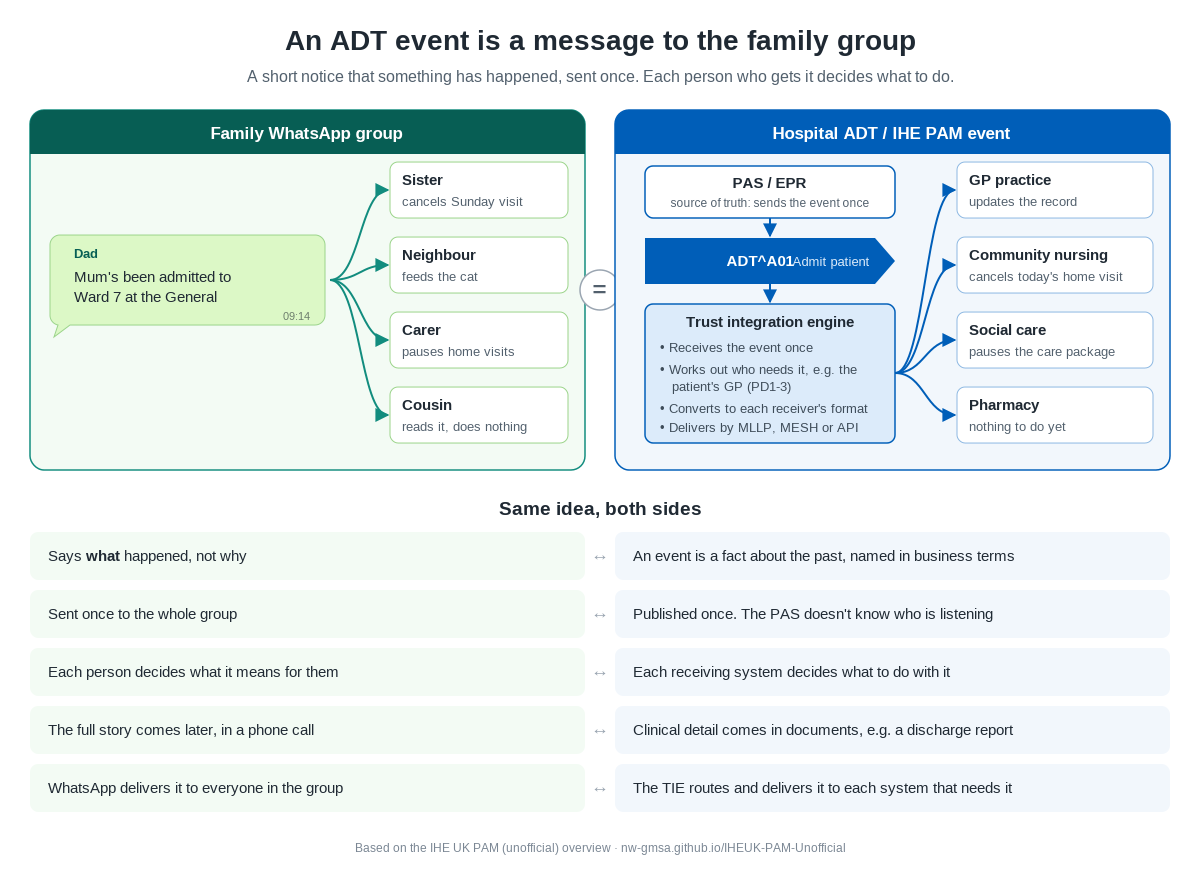
When Dad posts “Mum’s been admitted to Ward 7”, he sends it once. He doesn’t say why, and each person decides what it means for them. The sister cancels her visit, the carer pauses home visits, and the cousin does nothing. An ADT^A01 works the same way. The PAS sends it once, and the Trust integration engine routes it to the GP, community nursing, social care and pharmacy, who each act on it. The clinical detail comes separately, in documents such as the discharge report.
Within a Trust, the integration engine does the routing. Outside the Trust, there’s no national equivalent for these encounter events, and that’s the gap I’m trying to describe.
I’d especially like to know:
- Does the analogy hold up, or does it oversimplify something important?
- Is the FHIR argument fair?
- What’s missing or wrong about MNS/MESH?
- Do the patient journeys (inpatient, outpatient, virtual ward) match what you see locally?