Do we need an Open Health Technology Foundation?

My position is that “relative ease” for anything but common or non-complex functionality currently means (for example) I had to spend 2 hours yesterday explicitly and repeatedly telling the agentic coder to exactly replicate the medical UI for the v6 file version or our practice monitoring platform despite my having previously implemented and perfected the v5 version over the last year so it had existing examples to follow. The two hourse were spent to double-checking and repeatedly pointing out that it had implemented absolutely nothing the same as the previous version (including randomly changing the patient selection criteria !?!) - for which it apologised profusely but only made the modifications with explicit identification and repeated explanation of what it had still done wrong every loop (and it would totally drop the ball if I gave it more than one at once). And this despite me having explicit specifications, deterministic evaluation scripts, and screen based checking. Agentic coders remain unreliable for implementation of complex functionality unless you have a human double-checking absolutely everything. Thus if you are doing anything which requires complexity, reliability, or highly specified operation (eg most clinical tools), they still have a long way to go. This is probably marginally better than 12 months ago, but is definitely not the orders-of-magnitude improvement I had expected over the past 12 months. And this is essentially the same whether I’m coding C++, Python, or a React Native app. For every 2 hours of agentic coding I have found it needs at least as much time running deterministic tests and then another hour of testing to ensure it does what the task/contract it was given explicity stated. And if you don’t watch it much of the time it’s coding it has a high chance of going off piste…

So to rewrite that component from scratch would likely have taken me 10 hours to handroll - but it still isn’t a negligible investment of time and expertise.

Similarly with a running coach app I’ve written for my phone - theres about a 30% chance that any new feature will result in it breaking some existing feature - and even with emulation and automation on a real phone running literally hours of simulated runs, problems still slip through and only become apparent during the live human-tested run.
Anyone had a look at https://dhcf.eu/

DHCF envisions an ecosystem where digital health ‘just works,’ allowing time and resources to be invested in patient-professional relationships and technological advancements. We support “custodians” who develop sustainable solutions, in alignment with European digitilisation standards and values.

I couldn’t identify any custodians or related projects?

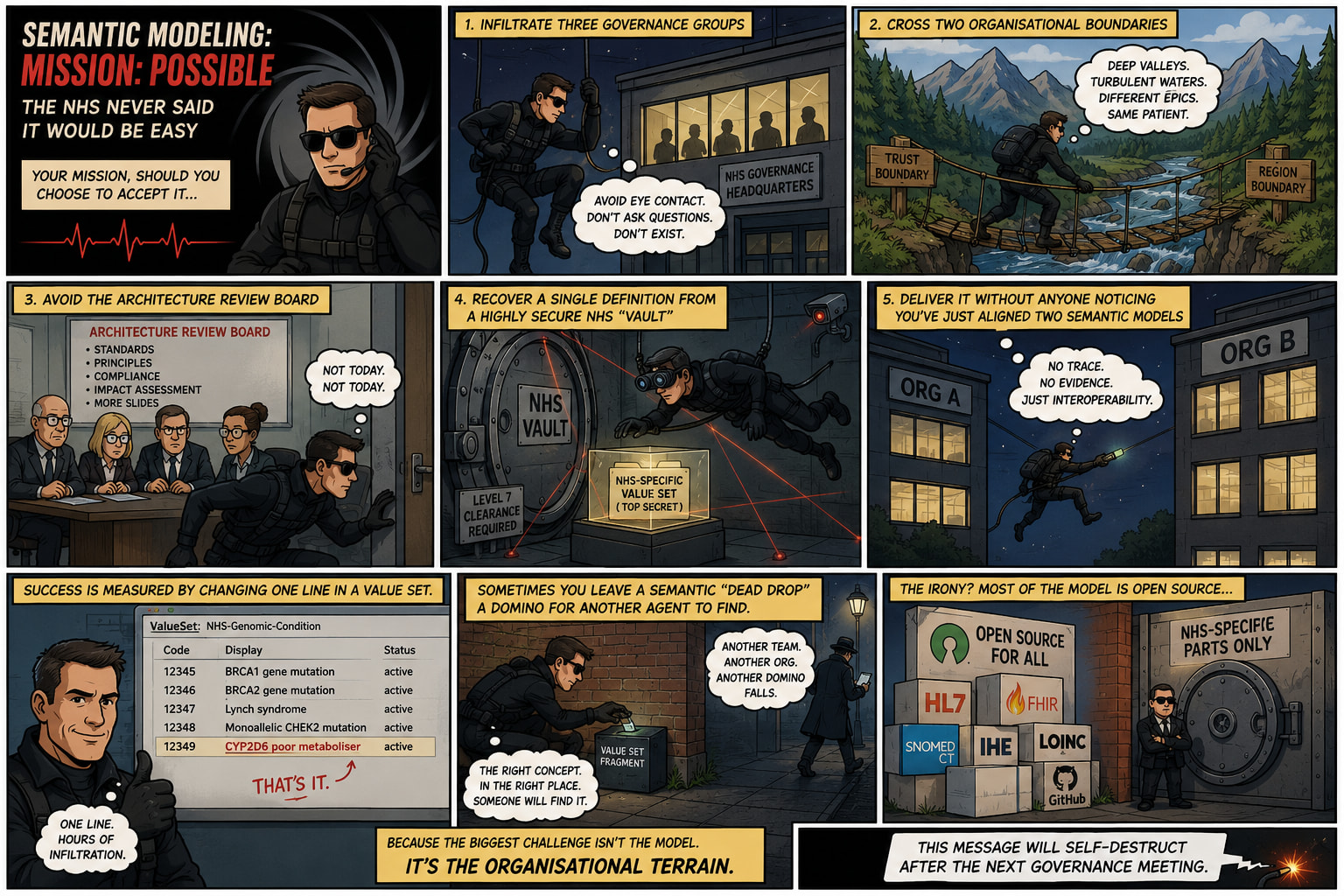
My experience around health is this:

Although that is focused on semantic models, similar occurs around workflow (the clinical pathways are ‘hidden’) and also the core models. I think the main problem here is focusing on the data rather than the engineering (which is often focused on pathway) - it’s the engineering side that tends to become black ops.

Software is a little better as some elements of the above are included but it is mostly aimed at a small group of clinicians or a narrow part of the pathway. These often don’t scale up to work in an enterprise, core + semantic models are added as an after thought.

On both sides I feel more emphasis on process and then software+data is needed. The main org that takes this approach is IHE and it value is in early stages of development. The later stages can be handed off to other orgs such as openEHR, HL7, etc which go into more detail.

The general problem is lack of openness.

I hadn’t heard of this, so thanks for sharing. However looking at their website it looks like the website is all they have (apart from a series of chats with practically everyone who attended EHRCON24…)

I am proposing a CIC that would look after the code. It would be run by its members and membership would buy you into the running of the org. The primary membership benefit would be the legal indemnity / liability protection afforded by having open source work owned by OHTF, not by an individual.

It won’t be an idea all of you will like. I’m fine with that. It will be 100% open source and no exceptions, for example. But I think this model has potential.

Happy to discuss the idea back and forth here, but can we please keep the discussion about the subject of the OP - “Do we need an Open Health Technology Foundation?” not about the actual details of semantic modelling, agentic coding, or standards - they are all things that absolutely should be discussed, but please create new threads for them.