Common cross-organisation interoperability problems
Several interoperability problems recur across NHS and care organisations, and many fall outside the current scope of NHS England’s national programmes:
- Hospital discharge notifications to other care providers: a candidate solutions already exists.
- Document indexing: there is no common standard. A candidate solution exists, and NHS Scotland’s standards would be a good starting point.
- Using EHDS and UK Core in practice: these data standards exist, but practical adoption in real-world interoperability is limited.
- Eurdice API standards: their potential for UK adoption has not been explored.
- Document and discharge report exchange: multiple candidate solutions exist, such as ORU_R01 and MDM_T02.
Why is this needed?
These problems sit in a no man’s land between NHS provider organisations (and their suppliers) and NHS England. Providers and suppliers solve their own integrations but have no remit to set common patterns. NHS England sets national standards but doesn’t cover every cross-organisation problem.
The logical owners are ICBs, because cross-organisation problems show up at system level. However, ICBs often lack in-house engineering capability, so these problems go unowned and organisations keep solving them separately.
How should we solve them?
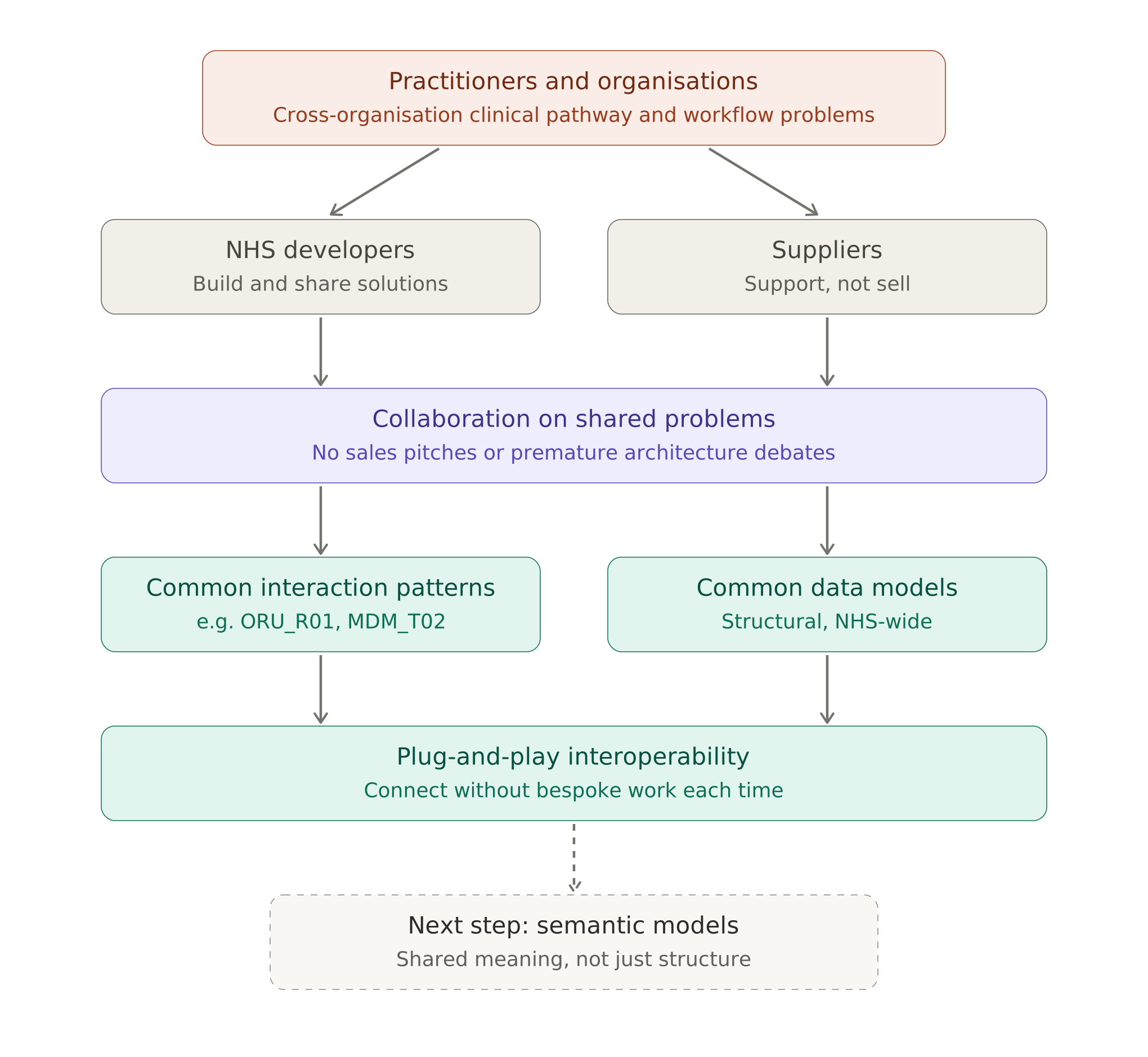
One option is an interoperability user group with two types of members:
- NHS and care organisation developers, who bring real-world problems and share ideas and solutions with peers.
- Suppliers, who attend to help solve cross-organisation problems, not to sell. Their contributions show what their products and services can do, giving them a credible, non-sales way to demonstrate their value.
Many of these problems already have candidate solutions. The group would give them a place to be showcased, tested and refined, with the aim of taking the strongest forward as formalised UK standards or patterns.
What other approaches could work, and what would it take to make them stick?
Ideally I’d also like this to focus on:
The patient angle
Many of these problems come from serious failures in communication along clinical pathways. Having seen several stages of a cancer pathway last year, I found that basic, simple interoperability support was often missing.
- “Records are stuck with NHS Trust ABC.” In interoperability terms, the trust had no method of sending or sharing even a PDF document with other care providers.
- No patient summary. The summary existed on the ReSPECT form, but the GP surgery hadn’t printed it off, so it wasn’t available when needed. In interoperability terms, the information depended on a paper copy rather than being shared electronically between care settings.
As a result, the burden shifts to patients, often elderly ones, to carry information between organisations. That is not the answer. Many patients reasonably assume the NHS shares its own records with itself, so they don’t think to pass information on. In our case, this meant important details were left out, including the main condition.
These are not advanced interoperability problems. They are basic document and summary exchange, and patients feel the gaps directly.
Won’t the Single Patient Record solve this?
It’s understandable to expect that the NHS Single Patient Record will solve these problems. However, it is likely to take time, and it appears to be taking a care-setting-by-care-setting approach, starting with maternity.
At a more technical level, NHS England appears to be focusing on Shared Record Providers at ICB level. This leaves a gap between NHS providers and their suppliers on one side and Shared Record Providers on the other. This group could help fill that gap.
There are relatively hidden but well-known common patterns in this space, including several of those listed above. Without central coordination, NHS trusts with limited funding risk being asked to solve the same problem several times over. In our case, as an NHS provider, we are probably working with at least four shared record suppliers.
I completely agree that a group like what you are proposing could make interop much easier. If you are going to set something up I would be very careful to make it fully independent and financially sustainable. The most important rule is: Do Not Be Dependent on NHSE/DHSC Funding To Run It at ANY Point.
I think this sort of thing is what was envisioned by the PRSB originally, over 10 years ago when it was set up. However in 2025 it was defunded by NHSE, which I think stems from commercial voices within NHSE (ie Palantir and FDP people) telling them 'Where we’re going, you won’t need interop" - essentially the FDP or SPR will solve it all. I tried to suggest to PRSB several times (direct email and in-person communications with senior figures working there) that they should go the final mile and produce technical artefacts that directly implemented their standards, as opposed to just publishing PDFs and web pages. They patted me on the head and said they were doing just fine in their own estimation.
INTEROPen was another group, much more supplier-focused and practical, again doing good work to try to reduce duplication of effort in interoperability. INTEROPen had a heavy FHIR focus, but that probably just reflected the fact that FHIR was new at the time and was catching on quickly. INTEROPen was defunded by NHSE in 2019 and had to find another model. Their webpage is gone now, and their Ryver chat room is in read-only mode, suggesting they closed down.
I am happy to offer Open Health Hub’s support to anything you decide to set up, if you need forums and collaboration tools, for example.
It’s not easy to cross the divide between clinical informatics and practical implementation, and the same occurs inside NHS England.
I do think this can be engineered a lot better - data engineering (inc Machine Learning) is hopefully going to push for better data. This should make it easier to adopt clinical informatics standards, a problem with practical implementation is we need consumers to want better data - just saying it’s SNOMED doesn’t wash, they actually need to have it as SNOMED (or LOINC).
And its really hard to convey that information when you’re in a diabetic coma.
As an NHS patient I would like to be able to respond to the request for permission to share data with ‘when it comes to the NHS not only do you have permission you have a duty!’